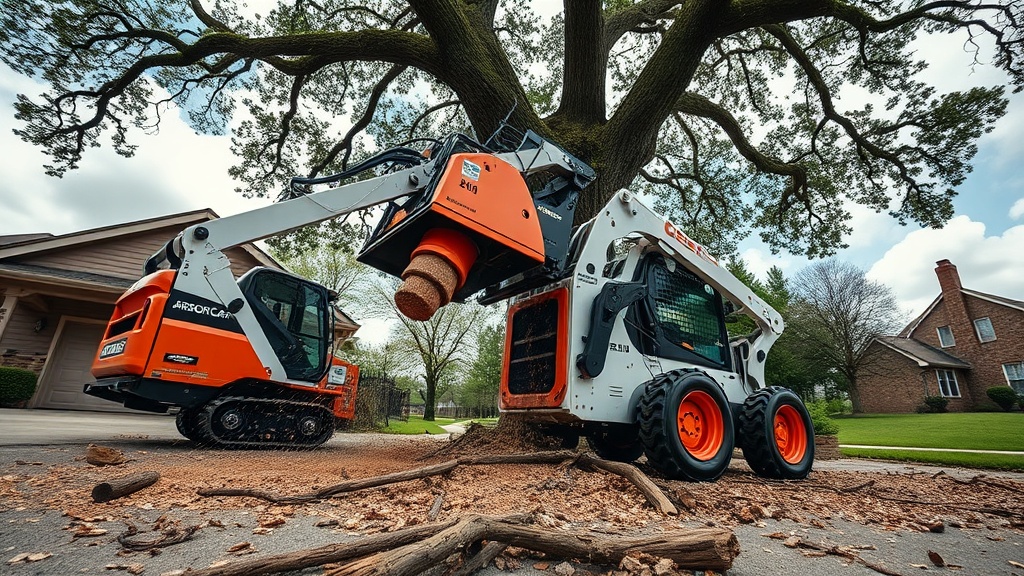
ArborClear Tree Shear Attachment: Storm Damage Cleanup Techniques
When severe weather strikes, property owners and arborists face the urgent task of clearing fallen or dangerously leaning trees. The ArborClear Tree Shear Attachment transforms a standard skid steer or excavator into a powerful cleanup machine, capable of cutting through storm-damaged timber in seconds. This article explores how this heavy-duty attachment speeds emergency response, reduces manual labor, and restores safety after a storm.
Unlike chainsaws or manual handsaws that are slow and risky on unstable debris, the ArborClear Tree Shear Attachment snaps through trunks up to 60 cm in diameter with a single hydraulic cycle. Whether you’re a professional tree service or a municipal crew, understanding its role in post-storm cleanup can save time and prevent injury.
How Does the ArborClear Tree Shear Attachment Speed Up Storm Debris Removal?
After a hurricane, tornado, or ice storm, time is critical. Fallen trees can block roads, damage buildings, and create electrical hazards. The ArborClear Tree Shear Attachment mounts on heavy machinery in under 10 minutes and begins cutting immediately. Its dual-blade scissor action grips the trunk and severs it cleanly, even when the wood is splintered or saturated with water.
The attachment’s 360-degree rotation (on suitable carriers) allows operators to access trees from any angle without repositioning the base machine. This is especially valuable in tight urban environments where a tree has fallen across a driveway or onto a roofline. A typical cleanup that might take four hours with chainsaws and hand trimming can be reduced to under one hour with the ArborClear unit.
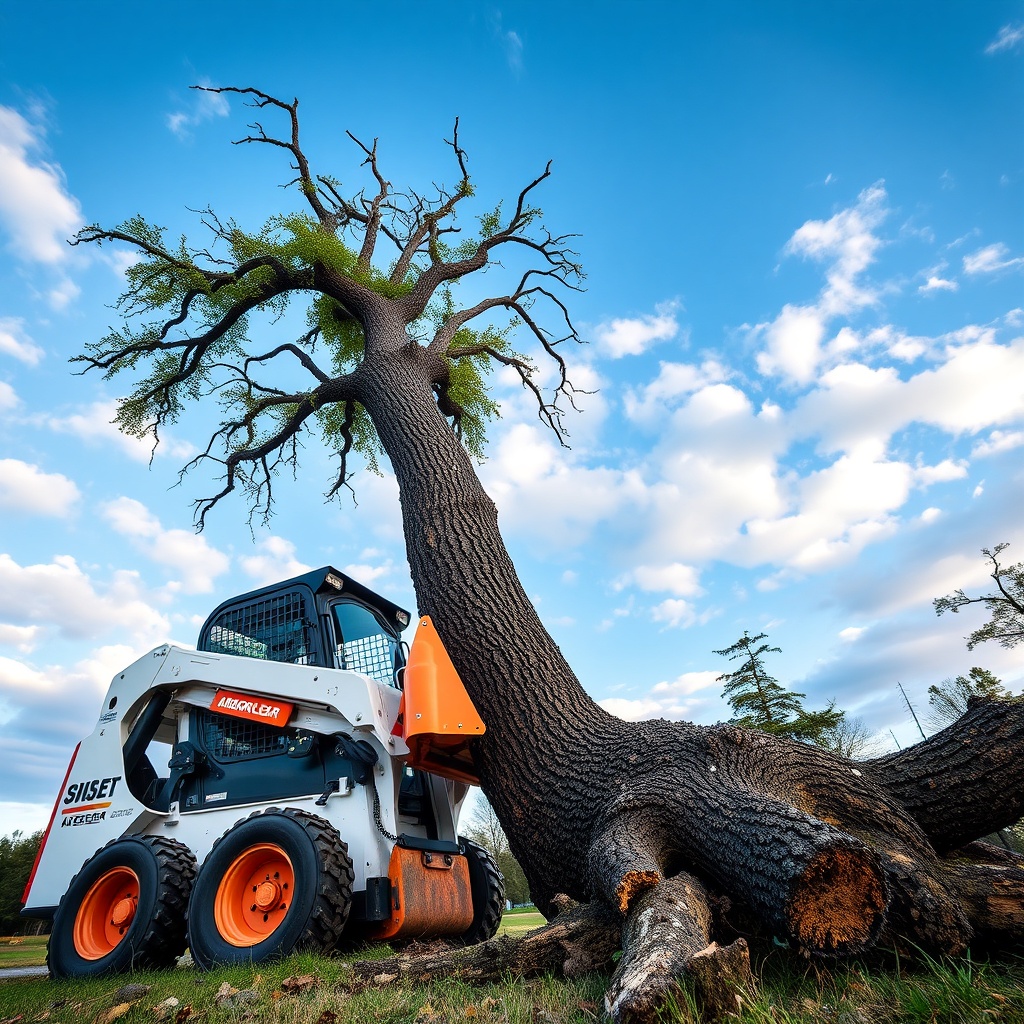
What Are the Key Specs of the ArborClear Tree Shear for Emergency Response?
Understanding the technical specifications helps operators match the attachment to the job. The ArborClear model most commonly used for storm cleanup is the ACS-60, but other sizes exist for lighter or heavier work.
| Specification | ACS-60 Value | Benefit in Storm Cleanup |
|---|---|---|
| Max cutting diameter | 60 cm (24 in) | Handles large storm-felled hardwoods like oaks and maples |
| Blade opening | 65 cm (26 in) | Accommodates irregular-shaped trunks and multiple stems |
| Hydraulic flow requirement | 80–120 L/min (21–32 gpm) | Compatible with most mid-size skid steers and excavators |
| Weight | 450 kg (992 lb) | Adds stability without overloading carrier lifting capacity |
| Blade material | Hardened AR600 steel | Resists chipping from hidden debris like nails or stone |
| Rotation | 360° continuous (optional) | Precise positioning in cluttered disaster zones |
| Cycle time | 3–5 seconds per cut | Rapid debris processing, up to 60 cuts per hour |
For smaller debris less than 30 cm, the ArborClear can process multiple branches in one pass, significantly boosting productivity. The optional hydraulic thumb kit further allows the operator to pick and sort debris without switching attachments.
Why Is Chainsaw-Free Operation Safer in Storm Damage Zones?
Storm-damaged trees are inherently unstable. They may be under tension from leaning, have split trunks, or be entangled with power lines. Using a chainsaw in these conditions is extremely dangerous—kickback, pinched bars, and falling limbs are common hazards. The ArborClear Tree Shear Attachment removes the operator from direct contact with the cut.
With the ArborClear, the operator sits safely inside the cab of the skid steer or excavator, protected by the ROPS/FOPS structure. The hydraulic power does the cutting, and the machine’s weight maintains stability even on uneven ground. Additionally, the shear’s design keeps the cut tree held until the operator releases it, preventing unexpected rolling or dropping. For ArborClear Tree Shear Attachment: Emergency Tree Services After a Storm, this safety advantage is non-negotiable.
Another safety factor is the elimination of sharp, moving blades exposed to ground personnel. The cutting action is contained within the shear’s head, and the only person near the cut zone is the machine operator. This reduces the risk of injury to crew members who might otherwise be holding branches or steadying ladders.
How to Prioritize Trees for Cutting After a Storm
When faced with dozens of downed trees, operators must quickly assess which to tackle first. The ArborClear attachment excels at cutting at ground level, but strategic prioritization maximizes efficiency. A common approach is the “access first” method: clear the nearest road or path to let other emergency vehicles pass, then move to trees threatening structures.
- Immediate threat trees: Those leaning on homes, cars, or power lines. Use the ArborClear for a quick, safe cut near the base, then remove the crown with the machine’s grapple bucket or the shear’s rotation.
- Blocked access points: Downed trees across driveways, sidewalks, or emergency lanes. Cut them into 2–3 meter sections for easy removal by dump truck or chipper.
- Hanging limbs and widowmakers: Limbs caught in upper branches. The shear can reach up to 4 meters with an extended arm, but for higher work, a bucket or crane attachment is needed.
- Root wads and flipped trees: Trees uprooted with root plates exposed. Cut the trunk where it bends, then use the shear to cut the roots if they need to be removed. For ArborClear Tree Shear Attachment: Stump Grinding Tips for Smooth Removal, leaving stumps short reduces grinding time later.
This systematic approach prevents operators from wasting time on low-priority debris while high-risk trees remain untreated. It also reduces the chance of secondary damage from falling branches after the initial cut.
What Techniques Work Best for Wet, Heavy Timber?
Storm-damaged wood is often waterlogged, making it heavier and more prone to splitting. The ArborClear Tree Shear Attachment is designed to handle wet timber, but operators should adjust their technique. First, approach the tree from the uphill or stable side to avoid mud or slippery surfaces. Second, make a single, decisive cut rather than multiple smaller ones—the hydraulic pressure will push through the fibers cleanly if the blade is sharp.
If the timber is over 50 cm and highly saturated, a “precut” of any small branches near the base can relieve stress on the trunk. Then, position the shear as low as possible (within 15 cm of ground level) to maximize stability. The machine should be on solid ground, not on the root wad. For conifers that are top-heavy with wet snow, cutting at a slight angle (around 10 degrees) helps prevent the top from falling backward onto the cab. For more on handling specific tree types, see ArborClear Tree Shear Attachment: Species-Specific Removal for Hardwoods.
How to Manage Debris Volume and Haul Away Efficiently?
Once trees are cut into manageable lengths, the real work of site restoration begins. The ArborClear attachment is not just a cutter—it can also be used to pick up and carry logs if the machine has a compatible quick coupler. However, for high-volume debris, a separate grapple or thumb is recommended. Sort debris into three piles: firewood (>15 cm diameter), chipping material (5–15 cm), and brush (<5 cm). This streamlines disposal and can reduce landfill fees.
For storm cleanup crews, the ArborClear’s ability to cut at ground level means stumps are left flush, which is critical for mowing and landscaping. If stumps must be removed entirely, the shear can cut them below ground level (down to 20 cm) for easier grinding later. Many arborists windrow logs along the property edge for later pickup, rather than trying to load every piece immediately. The key is to keep the machine moving: cut, sort, and stack systematically. In dense suburban areas, a single operator with an ArborClear can clear an average lot in 2–3 hours, compared to 8–10 hours with a chainsaw crew.
What Owners Say About the ArborClear in Storm Cleanup
Professional tree service owners and municipal operators consistently praise the ArborClear Tree Shear Attachment for its reliability and speed in emergency situations. “After Hurricane Ian, we used the ACS-60 on a Cat 289D skid steer. We cleared 47 trees in a single day—that’s three days’ work with chainsaws,” says Mark Jensen, owner of Jensen Tree Services in Florida. “We saved at least £1,200 in labor costs on that one job.”
In the UK, where storm Eunice caused widespread damage in 2022, arborist Sarah Blythe of London Green Care reports: “The ArborClear handled the heavy oaks and sycamores without a hitch. One cut per tree, and we never left the machine. Safety was our top priority, and this attachment delivered.” She notes that the initial investment of around £4,800 for the ACS-60 paid for itself within two seasons of storm work.
Another operator, David Kim from Toronto, Canada, underscores the attachment’s durability: “We had to cut through a maple that had a steel fence embedded in it. The ArborClear blade didn’t even nick. We just slowed down and cut through the fence too. That thing is tough.” However, some users note that for very large softwoods (over 60 cm), a first pass with a chainsaw to reduce weight is advisable to avoid stressing the shear’s hydraulic components. For advanced felling methods, refer to ArborClear Tree Shear Attachment: Advanced Tree Felling Techniques for Professionals.